

Role: Product & Experience Architect
Bridging Modular Hardware and Software Through UX-Driven Synthesis Design
Executive Summary:
-
UX Director
-
Systems Designer
-
Technical Concept Researcher
-
Product Strategist
-
Innovation Lead
Vision
As a UX designer working primarily in complex systems, I set out to rethink the interaction model between software-based synthesis and hardware modular environments. The goal was to create a seamless bridge between DAW-native instruments and voltage-controlled (CV) modular systems—removing friction between digital composition and physical signal flow.
Hardware Strategy :
"CV from Software"
To send control voltage (CV) from software to hardware, I explored the underlying signal logic:
-
CV is ultimately an analog waveform.
-
Digital signals can be converted to analog via DAC (Digital-to-Analog Conversion).
-
Multi-output audio interfaces can transmit precise control signals.
Instead of building a standalone hardware unit, I designed the system to leverage existing multi-output audio interfaces, allowing CV signals to be routed directly from the DAW to modular hardware.
This reduced friction, avoided unnecessary hardware production, and aligned with existing studio workflows—an important UX decision.
Hardware Domain
 Marving WorkStation |  Marvin Pro BOX SoundCard & midi / CV |  Modular Vs |
|---|---|---|
 KEY |  MIDI Expander and Sync |  MIXER |
 TOUCH |  Marving Setup Options |
Software Design — Modular
Inspired by Don Buchla and classic modular philosophy, I designed a flexible synthesis environment including:
-
ADSR envelopes
-
LFOs
-
Wave-table VCOs
-
Sequencers
-
FX modules
-
CV routing matrix
The system balances modular depth with usability—avoiding the intimidation factor of traditional patch-heavy environments.
Software Domain
 Marving Modular Software |  Marving 2U Modules Series |  WestCoat Modules Series |
|---|---|---|
 Surf Sonic Modules Series |  Software DAW | TOUCH |
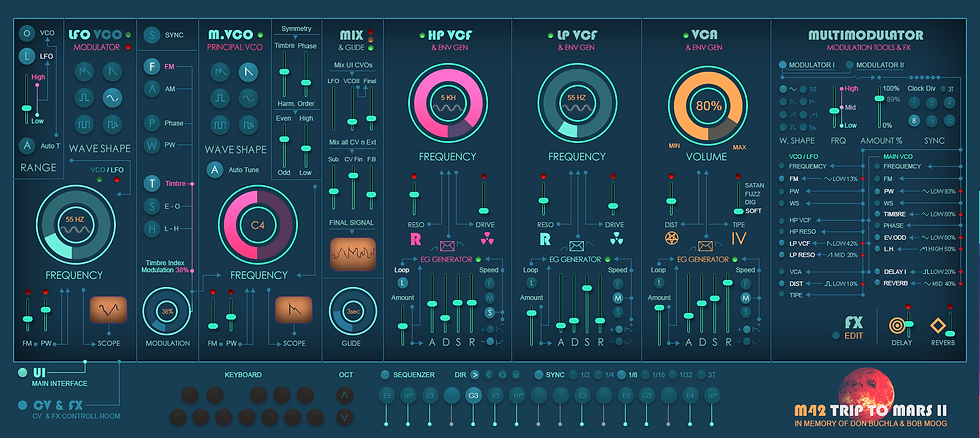
Trip to Mars (VSTi)
A fully functional VST instrument designed for DAW integration.
Two Interaction Modes:
-
Classic Mode
A familiar subtractive synth interface for immediate sound design. -
CV / Modular Mode
A fully patchable environment where users connect modules using virtual cables—mirroring real-world modular workflows.
This dual-layer UX approach lowers the entry barrier while preserving modular freedom.


Business & Industry Engagement
-
Self-funded R&D project (developed alongside my work as a UX Director).
-
Exploratory discussions with Waves Audio.
-
Initial collaboration interest from Uli Behringer.
The project did not proceed due to resource constraints (development team recruitment), not due to product viability.
Current Status
On hold, but not abandoned.
Emerging AI-assisted development workflows may reduce the barrier to assembling the required technical stack and team. The concept remains strategically relevant, especially as hybrid hardware–software music production continues to grow.